Indian Head Agricultural 

Research Foundation


Register today
for the

2010 Crop Management Field Day

2010 Crop Management Field Day

July 20
Indian Head, SK

Check out our Events page for details.


IHARF On-Farm Research Guide &
Data Analysis Tool

Growers looking to perform their own basic research experiments now have two new tools to do so. IHARF has created an IHARF On-Farm Research Guide (PDF) and Data Analysis Tool (v.1.1) (Excel spreadsheet) to assist with the research.

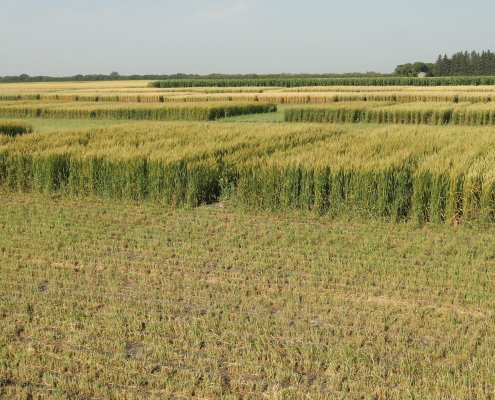
On-Farm Research Example Field Layout

The IHARF On-Farm Research Guide provides growers and agronomists with the information needed to conduct basic field experiments. The guide includes worksheets and sample calculations, as well as illustrations of possible field layouts. Complimenting the guide is the IHARF Data Analysis Tool (v1.1), an Excel spreadsheet that allows growers to easily input and analyze the research results.

The purpose of on-farm research is to test the success or failure of adopting new products or practices. Taking the time to properly implement simple experiments can be rewarding for a number of reasons. If a product or practice is consistently successful in field trials, it can be adopted with confidence. Failure, on the other hand, allows growers to save time and/or money by rejecting the change before adopting it on the entire farm.

On-farm research allows growers to assess what works and what does not on their own farms. Furthermore, by initiating their own trials, growers can have full control over the research that is completed and can increase their understanding of the design, benefits and limitations of research.

Download the: IHARF On-Farm Research Guide (PDF) and Data Analysis Tool (v.1.1) (Excel spreadsheet).

For more information, contact Chris Holzapfel at chris.holzapfel@agr.gc.ca.


Adaptation of Oilseed Crops in Saskatchewan

Canola quality Brassica juncea L. , and hybrid oilseed sunflowers have potential for greatly increased production in Western Canada. Juncea canola is a recently developed crop with seed quality similar to cultivars of Brassica napus L. and with canola quality similar to Brassica rapa L. (Woods et al., 1991). (Full Story...)


Natural Air Drying Systems

One of the realities of farming on the Canadian prairies is the time constraint associated with harvesting, not to mention the costs. When compared to direct seeding, one planter can easily do as much work as two large modern combines on a daily basis.

Waiting for the crop to be dry for safe storage before harvesting reduces the harvest window and increases the risk of crop deterioration. In order to increase the harvesting window, some producers make use of grain drying systems with heat and/or natural air drying.

Automatic grain drying systems are designed in such a way as to minimize over drying. With natural air drying systems, it is very difficult to prevent over-drying because by the time the drying front has reached the top of the bin, the grain at the bottom will be over-dried.  (Full Story...)


Field Pea in Rotation with Wheat

N fertilizer use in crop production contributes to nitrous oxide emissions (N2O). The substantial energy required to manufacture N fertilizers further contribute to greenhouse gas emissions and nitrogen fertilizers can account for 65-70% of total energy use in crop production. (Full Story...)


On-Farm Production of Bio-Diesel

The past two years have been filled with optimism regarding the use of vegetable oils from crops like canola as a partial replacement for diesel currently derived solely from fossil fuels. This optimism has also been reflected in higher prices for vegetable oil which is welcomed news for all producers.

There is also an assumption being made that producers, with a small investment, can get into the production of bio-diesel with relative ease and meet some of their fuel needs. After doing a bit of reading and talking to people in the know on this topic, it might be a bit more complicated than at first glance. (Full Story...)